

A sinking fund is a dedicated pot of cash you build on a schedule so that known, irregular expenses never blindside your budget. The formula is straightforward: take your goal amount, divide it by the number of months until you need it, and save that amount every month, adjusting as needed. A car insurance premium paid semi-annually can be covered by saving a consistent monthly amount starting now.
Three things to do right now:
- Pick one upcoming expense you always scramble to cover.
- Divide the total by the months remaining.
- Open a labeled savings account or sub-account and set up an automatic transfer for that amount on payday.
That's the whole system. Everything below makes it faster, smarter, and harder to break.
Table of Contents
- What exactly is a sinking fund, and where did the term come from?
- Why sinking funds make your budget more stable
- Sinking funds vs. emergency funds: which one comes first?
- What to actually save for: common sinking fund categories
- How to calculate and set up a sinking fund, step by step
- Where to keep your sinking funds
- Automation and tracking: how to make sinking funds stick
- Common mistakes that undermine sinking funds
- How Tended Money helps you manage sinking funds
- Key Takeaways
- The case for sinking funds that most guides miss
- Tended Money makes sinking funds automatic
- Useful sources for further reading
What exactly is a sinking fund, and where did the term come from?
A sinking fund is money you set aside incrementally for a specific, planned future expense. You know the bill is coming. You just spread the pain across months instead of absorbing it all at once.
The term itself has corporate roots. Investopedia traces it to bond markets, where companies would deposit money into a dedicated fund to retire debt over time, reducing default risk for bondholders. The mechanics were the same: steady, scheduled contributions toward a known future obligation. According to Wikipedia's history of the concept, the term migrated from public finance into personal budgeting frameworks, including zero-based and envelope budgeting, during the 2010s.
In personal finance, the goal isn't debt repayment. It's the opposite: you're building a cash cushion before the bill arrives so you never need to borrow in the first place.
Why sinking funds make your budget more stable
The core benefit is simple. Sinking funds convert infrequent, lump-sum bills into predictable monthly line items. Your budget stops lurching between "normal month" and "expensive month."
Practically, that means:
- No credit card debt for predictable costs — Putting a $1,200 home insurance premium on a card and carrying a balance costs you interest on a bill you knew was coming. MoneyRates notes that sinking funds directly reduce reliance on credit for these foreseeable expenses.
Sinking funds vs. emergency funds: which one comes first?
These two are often confused, but they solve different problems. A sinking fund covers planned expenses; an emergency fund covers unplanned ones. Your annual vacation is a sinking fund. A sudden job loss is an emergency fund situation.
The distinction matters for prioritization. If you have no emergency fund at all, build a small starter buffer first, typically $500–$1,000, before aggressively funding sinking funds. That buffer prevents a genuine surprise from derailing the sinking fund system you're building.
Once you have that baseline, the two can run in parallel. Your emergency fund sits untouched in a high-yield savings account. Your sinking funds fill up on schedule and get spent as planned. They don't compete; they complement each other.
If you're carrying high-interest debt, the calculus shifts. Paying down a 20% APR credit card balance usually takes priority over both, since the interest cost outpaces any savings benefit. But even then, a small sinking fund for truly predictable annual expenses, like car registration or a subscription renewal, can prevent you from adding new debt while you pay down the old.
What to actually save for: common sinking fund categories
Almost any predictable, irregular expense qualifies. The most useful way to think about it: if you'd be surprised by the bill even though you knew it was coming, it needs a sinking fund.
Annual and semi-annual bills:
- Car insurance premiums
- Home or renters insurance
- Property taxes
- Vehicle registration
- Annual subscriptions (software, streaming bundles, memberships)
Maintenance and repairs:
- Car maintenance (oil changes, tires, brakes)
- Home repairs (HVAC service, appliances, roof)
- Medical or dental out-of-pocket costs
Special events:
- Holiday gifts and travel
- Birthdays and anniversaries
- Weddings or family gatherings you're attending
Freelancer-specific:
- Quarterly estimated taxes
- Professional development or certifications
- Equipment replacement
Quick worked examples:
- Car repair fund: You expect to spend $1,200 on car maintenance over the next year. That's $100/month.
- Insurance premium: A semi-annual premium due in several months can be saved for by setting aside a consistent monthly amount.
- Holiday gifts: You want $800 for December gifts. Starting in May gives you seven months: roughly $115/month.
Prioritize essentials first. Fund the car insurance before the vacation. Fund the property tax before the birthday trip.
How to calculate and set up a sinking fund, step by step
NerdWallet's guidance frames the method as reverse-engineering your goal: start with the target amount and work backward.
The formula: Goal amount ÷ months until due = monthly contribution.
Three worked examples across different timelines:
| Goal | Amount | Months | Monthly Contribution |
|---|---|---|---|
| Car tires | — | — | $100 |
| Holiday travel | — | 10 | — |
What to record for each fund:
- Goal name (be specific: "December gifts," not "holidays")
- Target amount
- Deadline month
- Monthly contribution
- Account or sub-account where it lives
- Automation cadence (weekly, biweekly, or monthly)
On rounding and buffers: Round up, not down. If the math gives you $94/month, save $100. Add a 5–10% buffer on top of your estimate for anything involving labor or repairs, since quotes almost always come in higher than expected. For example, a car repair estimate should include an extra margin above the quoted amount.
Where to keep your sinking funds
The right account depends on your timeline. The guiding principle: keep sinking funds in stable, liquid vehicles rather than investment accounts. A market dip the week before your insurance premium is due is not a risk worth taking.
| Timeline | Recommended Account | Why |
|---|---|---|
| Under 3 months | Checking sub-account or savings bucket | Instant access, no transfer delay |
| 3–12 months | High-yield savings account (HYSA) | Earns interest, still fully liquid |
| 12–— months | Money market account | Slightly higher yield, easy access |
| —+ months | Short-term CD ladder | Higher rate, predictable maturity dates |
Consumer finance guides consistently recommend high-yield savings accounts or labeled sub-accounts for most sinking funds, since they earn interest without locking up your money.
On safety: Bank deposits are insured by the FDIC up to $250,000 per depositor, per institution. Credit union deposits carry equivalent protection through the NCUA. Either way, your sinking fund money is protected as long as you stay within coverage limits.
One practical note: keeping sinking funds in a separate account from your everyday checking makes them harder to accidentally spend. Out of sight, out of reach.
Automation and tracking: how to make sinking funds stick
Automation is the single most important step after you've done the math. A transfer you have to remember to make is a transfer that eventually doesn't happen.
Align automatic transfers with your paydays. If you're paid biweekly, set two smaller transfers per month rather than one large one at month-end. This smooths the impact on your checking balance and keeps the habit invisible.
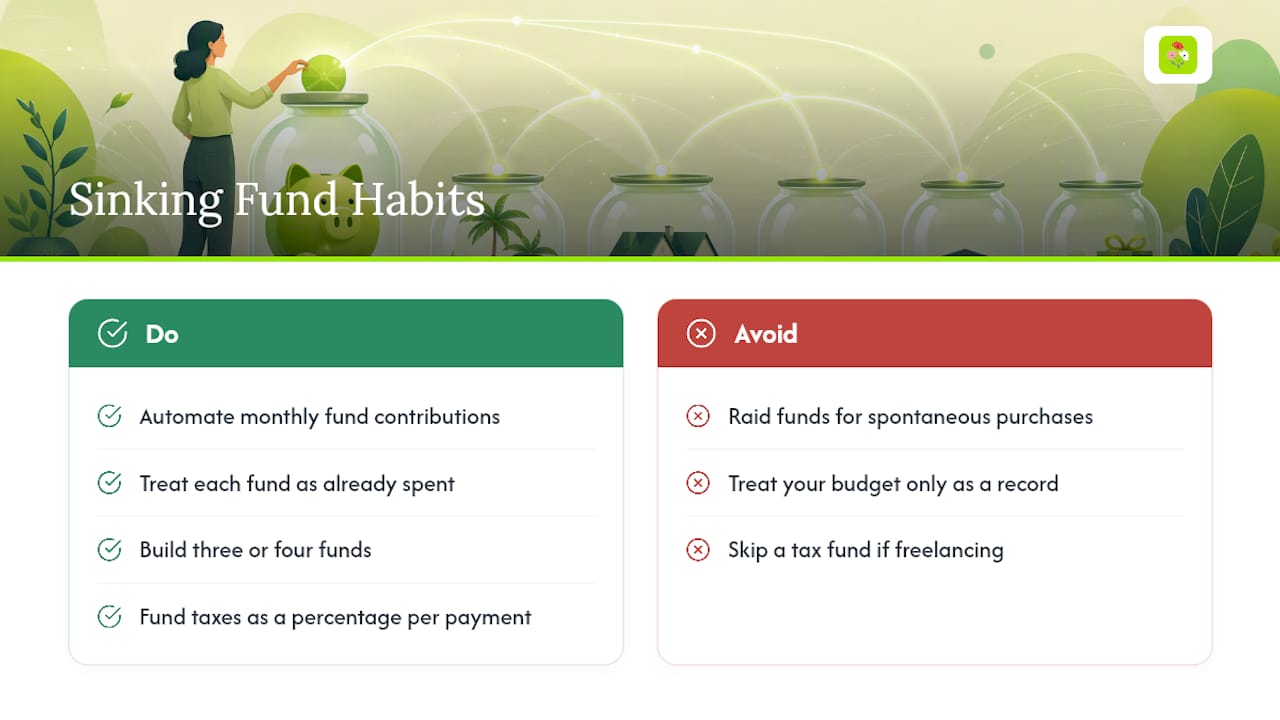
Naming matters more than most people expect. "Savings" is easy to raid. "December Gifts" or "Car Insurance — October" creates a psychological barrier. You know exactly what that money is for, and spending it on something else feels like a deliberate choice, not a casual swipe.
Pro Tip: When you receive a windfall, a tax refund, a bonus, or a freelance payment larger than expected, direct a portion straight into your most underfunded sinking fund before it hits your checking account. This can compress a 12-month timeline to 8 months without changing your monthly budget.
Check progress monthly, not daily. A quick glance to confirm each fund is on track takes two minutes and prevents the slow drift where you're three months behind without realizing it. Label each fund with its target and deadline so the progress is visible at a glance.
Common mistakes that undermine sinking funds
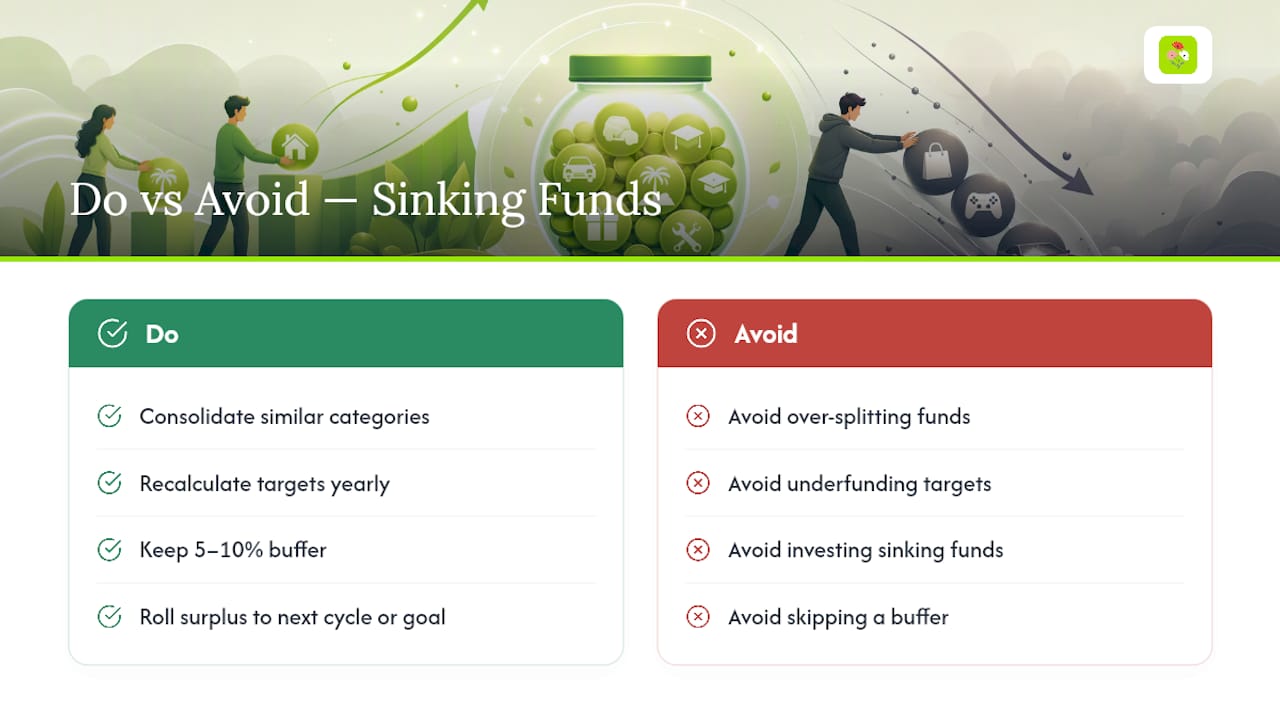
The most common mistake is creating too many small buckets. When every minor expense gets its own fund, the system becomes a spreadsheet nightmare and the amounts feel too small to bother with.
Mistake: Over-splitting. Fifteen funds with $15/month each are harder to manage than five funds with $45/month each. AccountingTools flags this fragmentation as a typical pitfall. Fix it by consolidating similar categories: one "car fund" covers insurance, registration, and maintenance rather than three separate buckets.
Mistake: Saving too little. Underestimating the target amount is common, especially for home repairs and medical costs. Recalculate annually and adjust for inflation or known cost increases.
Mistake: Putting sinking funds in investment accounts. A stock market fund is not a sinking fund. If your timeline is under two years, market volatility can leave you short exactly when you need the money.
Mistake: Skipping the buffer. Estimates are almost always low. A 5–10% buffer on any repair or service estimate is cheap insurance.
Handling leftovers: If a fund ends up overfunded because the expense came in lower than expected, roll the surplus into the next cycle of the same fund or redirect it to your most underfunded goal. Don't let it drift back into general spending.
How Tended Money helps you manage sinking funds
Tended Money is built for exactly this kind of structured, goal-driven saving. The app consolidates your accounts, budgets, and recurring bills in one place, so your sinking fund system lives alongside your full financial picture rather than in a separate spreadsheet.
Key features that support sinking funds:
- Budget buckets with labels: Create named buckets for each fund (car insurance, holiday gifts, HVAC) and track contributions against a target amount.
- Rollover handling: Tended's budget rollover feature carries unspent amounts forward automatically, so a month where you contribute a little extra doesn't get lost.
- Transaction rules and tags: Categorize transfers automatically so your sinking fund contributions are tracked without manual entry.
- Recurring bill tracking: See all upcoming bills in one view so you can match sinking fund timelines to actual due dates.
Three-step setup inside Tended:
- Create a named budget bucket for your first sinking fund goal.
- Set the target amount, deadline, and monthly contribution.
- Automate a recurring transfer from your checking account on payday.
On security: Tended connects to your bank using read-level access, and the app's data-handling approach is designed with privacy as a baseline. Your underlying accounts remain FDIC or NCUA insured at your bank or credit union regardless of which app you use to track them.
Key Takeaways
Sinking funds work because they turn unpredictable lump-sum bills into predictable monthly contributions, removing the budget shock that leads most people to reach for a credit card.
| Point | Details |
|---|---|
| Core formula | Divide your goal amount by months until due to get your monthly contribution. |
| Account choice | Use a high-yield savings account or labeled sub-account for most funds; avoid investment accounts. |
| Automation first | Set automatic transfers on payday so contributions happen without relying on memory. |
| Buffer rule | Add a margin to any repair or service estimate to cover cost overruns. |
| Tended Money | Use Tended's budget buckets and rollover feature to track and automate sinking funds in one app. |
The case for sinking funds that most guides miss
Here's what I think gets undersold in most sinking fund explainers: the psychological shift is more valuable than the math.
The math is easy. Divide by months, automate, done. What actually changes your financial life is the moment you stop experiencing a $1,200 insurance bill as a crisis and start experiencing it as a scheduled event. That reframe is worth more than any interest rate you'll earn on the account.
Most people treat their budget as a record of what already happened. Sinking funds force you to treat it as a plan for what's coming. That's a fundamentally different relationship with money, and it compounds. Once you've built three or four funds and watched them fill up on schedule, the idea of not having a fund for a known expense starts to feel strange.
The trade-off worth naming: sinking funds require discipline to leave alone. A labeled sub-account is not a lock. If you raid your car fund for a spontaneous purchase, you're back to scrambling when the tire blows. The system only works if you treat each fund as already spent. The money isn't yours for discretionary use; it belongs to the future bill.
For freelancers especially, sinking funds for quarterly estimated taxes are close to non-negotiable. Irregular income makes it tempting to spend every dollar that lands in your account. A dedicated tax fund, funded as a percentage of every payment received, is the difference between a manageable April and a genuinely stressful one.
Tended Money makes sinking funds automatic
Knowing the formula is one thing. Having a system that runs it for you is another. Tended Money gives you named budget buckets, automatic rollover, and recurring bill tracking in a single app, so your sinking funds build on schedule without requiring a monthly spreadsheet session.

Set up your first sinking fund bucket in minutes: name it, set the target, and let Tended handle the tracking. Start with Tended Money and turn your next irregular expense into a line item you've already planned for.
Useful sources for further reading
These are the primary sources behind this guide, worth bookmarking if you want to go deeper on any specific topic:
- What is a sinking fund? Guide to purpose-driven saving – MoneyRates
- Sinking Fund: Why You Need One in 2026 - NerdWallet
- What is a sinking fund | Discover
- Sinking fund - Investopedia
- Sinking Funds Explained: A Beginner’s Guide to Getting Started
- Sinking fund - AccountingTools
- Sinking fund
- National Credit Union Administration (NCUA)