

Aim to save a realistic amount before you move out, or at minimum three months of your projected living expenses plus all upfront move-in costs. That's the blunt answer. The exact number depends on your city, your rent, and whether you're moving across town or across the country, but that range covers a realistic first-time mover in most U.S. markets.
TL;DR: Upfront move-in costs (deposit + first month + moving expenses) typically run several thousand dollars, and a three-month emergency buffer adds a comparable amount on top. Together, that's your savings target before you sign a lease.
Three things to do right now:
- Use a moving expenses calculator to get a rough number for your move type (local or long-distance), then get at least three written quotes from movers.
- Open a dedicated savings account and label it "Move Fund" — separating it from your checking account makes the goal visible and harder to raid.
- Search current listings in your target neighborhood to pin down a realistic rent number, then run the affordability formula in Section 3 below.
Table of Contents
- What does a move out budget actually cover?
- How much should you save before moving out?
- What are the typical rent and move-in fees you'll pay?
- How much does moving actually cost?
- What will your monthly bills actually look like?
- What furniture and household items do you actually need first?
- How do you budget for health coverage and renter's insurance?
- How do debt payments and an emergency fund affect your move timeline?
- How do you build your moving-out budget step by step?
- What are the best ways to cut your moving and monthly costs?
- How long will it take you to save enough to move out?
- Key Takeaways
- The part most first-time movers get wrong
- Tended makes it easier to track your move-out savings plan
- Useful sources
What does a move out budget actually cover?
Most first-time movers think about rent and the moving truck. That's two of the three layers you actually need to fund. Miss the third and you'll be broke by month two.
Layer 1: One-time move-in costs. These are the expenses you pay once, before or during the move. Security deposit, first month's rent, application fees, truck rental or movers, packing supplies, and utility deposits. They hit all at once, which can catch people off guard.
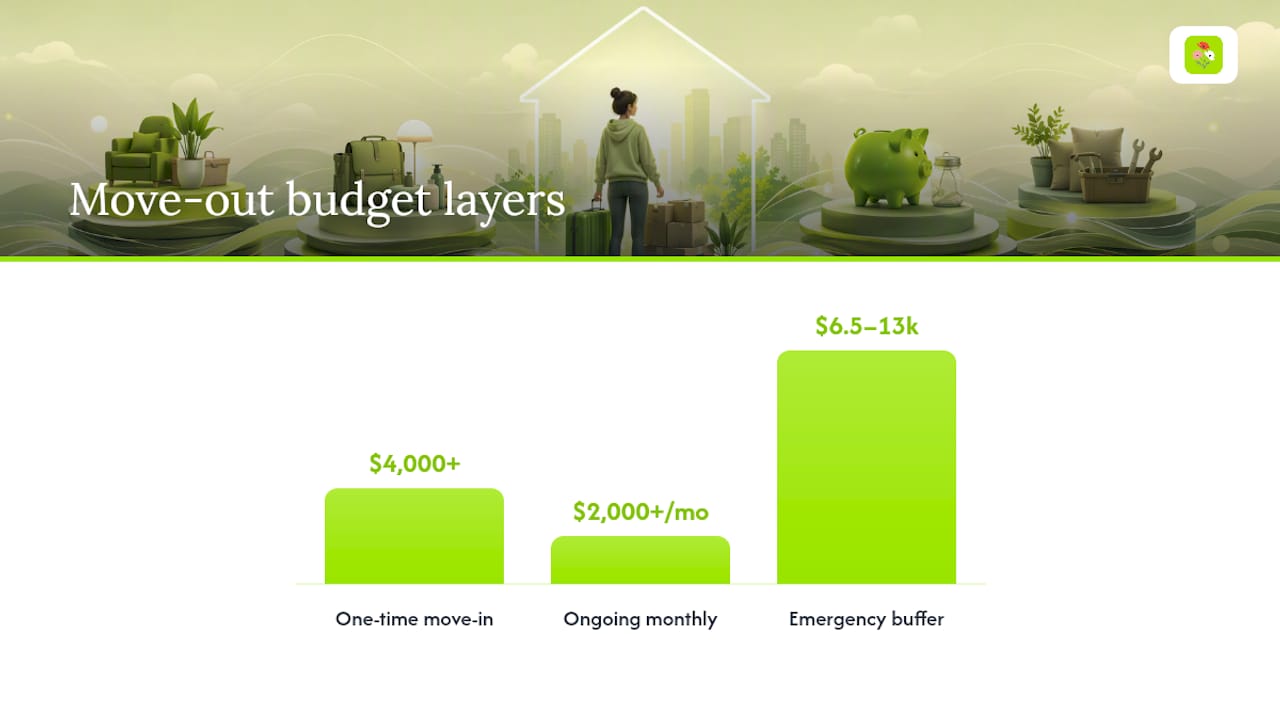
Layer 2: Ongoing monthly costs. Rent, utilities, groceries, phone, internet, renter's insurance, and transportation. These repeat every month, and they're usually higher than people expect when they're living on their own for the first time.
Layer 3: Emergency buffer. Three to six months of living expenses set aside and untouched. This is the layer most first-time movers skip entirely, and it's the one that determines whether a job loss or a medical bill derails the whole plan.
The cascade problem is real: underestimate Layer 1 by $1,500, and you drain savings that were supposed to cover Layer 3. Then one unexpected car repair in month four puts you behind on rent.
| Cost Type | Example Items | Typical U.S. Range |
|---|---|---|
| One-time move-in | Security deposit, first month's rent, application fees | $4,000 or more |
| Moving costs | Truck rental, movers, packing supplies, travel | Variable, often $800–$2,000 for a local move; more for long-distance |
| Monthly ongoing | Rent, utilities, groceries, phone, internet, insurance | $2,000+ per month for a moderate-cost city |
| Emergency buffer | 3–6 months of monthly costs | $6,500–$13,000 or more |
| Contingency (10%) | Unexpected fees, repairs, forgotten items | 10% of total budget |
According to a detailed relocation budget breakdown, a realistic moving budget should include one-time move costs, three to six months of new living expenses, and a 10% contingency on top. The mover's invoice is often the smallest line item once you add everything up.
Statistic: Move.org's industry data shows a 3-bedroom local move averages around several thousand dollars, while long-distance moves can be much higher depending on mileage and weight. Most first-time movers are moving a studio or one-bedroom, so local costs typically run lower, but the principle holds: moving itself is a four-figure expense.
How much should you save before moving out?
Here's the formula:
Savings target = Total upfront costs + (Monthly living costs × Buffer months)
Then add 10% on top as a contingency.
Worked example: solo renter, moderate-cost city
Say you're moving to a mid-size city like Columbus, Ohio or Raleigh, North Carolina. Your numbers might look like this:
- Rent: $1,400/month
- Security deposit: $1,400 (one month's rent)
- First month's rent: $1,400
- Application fee: $75
- Moving costs (local, one-bedroom): $800
- Packing supplies: $100
- Utility deposits: $200
- Total upfront costs: $3,975
Monthly ongoing costs:
- Rent: $1,400
- Utilities (electric, gas, water): $150
- Internet: $60
- Groceries: $350
- Phone: $80
- Renter's insurance: $18
- Transportation: $120
- Total monthly: $2,178
Three-month buffer: $2,178 × 3 = $6,534
Savings target (before contingency): $3,975 + $6,534 = $10,509
Add 10% contingency: $11,560
If you want a six-month buffer instead (recommended when your income is variable or you're in a new job), that number climbs to about $17,000. Choose three months if you have stable employment and a strong support network. Choose six months if you're freelancing, on a contract, or moving to a new city where you don't yet have a job locked in.
Rent as the last line item. The old "30% of gross income" rule breaks down fast in expensive markets. A better approach: take your monthly take-home pay, subtract every essential cost (food, transportation, insurance, phone, utilities, savings contribution), and whatever's left is the maximum rent you can afford. Financial experts at Discover specifically recommend this residual approach over the gross-income percentage rule. If the math doesn't work at your target rent, you either need to earn more, spend less elsewhere, or find a cheaper apartment.
What are the typical rent and move-in fees you'll pay?
Before you get keys, expect to write several checks in quick succession. Here's what landlords typically collect:
- Last month's rent: — Some landlords require this upfront, especially in competitive markets. That's three months' rent due before you move in.
Documents landlords typically want: government-issued ID, two to three recent pay stubs, last year's tax return (especially for freelancers), bank statements showing three months of reserves, and references from a previous landlord or employer. If you have thin credit, offering a co-signer or a larger deposit upfront can move an application forward.
Roommate note: Application fees are usually paid per person. Security deposits are typically split, but confirm in writing who gets what back and under what conditions. Spell out how monthly bills are divided before you sign anything.
Pro Tip: Ask the landlord directly whether the security deposit is negotiable if you pay several months upfront or provide a co-signer. In slower rental markets, many landlords will accept one month's deposit instead of two from a well-qualified applicant.
How much does moving actually cost?
The range is wide, and the variables matter more than the averages.

| Move Type | Estimated Cost Range |
|---|---|
| Local DIY (truck rental, studio/1BR) | $150–$450 |
| Local labor-only (movers, no truck) | $300–$700 |
| Local full-service (1BR) | $800–$1,700 |
Moving.com's cost data puts local move averages in the $1,250–$1,700 range for a typical household, while long-distance costs scale sharply with weight and mileage.
The variables that actually move the needle: distance (obviously), total weight or volume of your belongings, specialty items (pianos, gun safes, large artwork), access constraints (no elevator, narrow stairwell, long carry from truck to door), and timing. Moving in May through August costs more than moving in January. Saturday moves cost more than Tuesday moves.
"Always get at least three written quotes after a virtual or in-home survey — never treat an online calculator as a final price. Access constraints, elevator booking windows, and specialty items can add hundreds to a quote that looked fine on screen." — Move.org moving cost guidance
Questions to ask every mover before you book:
- Is this a binding or non-binding estimate?
- What's included in the base rate (fuel, blankets, shrink wrap)?
- What's your policy on delays or damage?
- Are you licensed and insured? (Verify at FMCSA.dot.gov for interstate moves.)
- Do you subcontract any part of the move?
DIY vs. pro: Renting a truck yourself saves money but costs time, physical effort, and carries real risk of damage to your belongings or the vehicle. Full-service movers cost more but reduce stress and liability. For a studio or one-bedroom with minimal furniture, DIY is usually worth it. For anything larger, or if you're moving more than 200 miles, professional movers typically pay for themselves in reduced damage and time.
What will your monthly bills actually look like?
This is where first-time movers get surprised. Rent is the big number, but the line items below it add up to several hundred dollars a month before you've bought a single grocery item.
Typical monthly ranges for a single adult in the U.S.:
- Electricity: $80–$150 (higher in summer with AC, higher in cold climates with electric heat)
- Gas/heating: $30–$100 (varies sharply by climate and whether your unit uses gas)
- Water/sewer: $20–$60 (often included in rent; confirm before you sign)
- Internet: $40–$80
- Phone: $35–$85 (prepaid plans can cut this significantly)
- Groceries: $250–$450 (the BLS Consumer Expenditure Survey provides defensible baseline figures by household size and region)
- Transportation: $80–$200 (transit pass) or $300–$600 (car payment + insurance + gas)
- Renter's insurance: $15–$30/month
- Streaming/subscriptions: $20–$60 (audit these before you move)
The rent-as-last-line-item calculation in practice: Take your monthly take-home pay. Subtract groceries, transportation, utilities, phone, insurance, and a savings contribution. What's left is your rent ceiling. If that number is $1,100 and the apartments you're looking at start at $1,400, the math is telling you something important.
Regional adjustment matters. Utilities in Phoenix run higher in summer than in Minneapolis. Groceries in San Francisco cost meaningfully more than in Kansas City. The BLS data gives national averages, but check local utility provider websites and current grocery prices in your target city for a sharper estimate.
Sample monthly budget row list (copy into a spreadsheet or budgeting app):
- Rent
- Electric
- Gas/heating
- Water/sewer
- Internet
- Phone
- Groceries
- Transportation
- Renter's insurance
- Subscriptions
- Emergency fund contribution
- Debt payment (if applicable)
- Personal care/household supplies
What furniture and household items do you actually need first?
Buy in this order. Everything else can wait.
Buy immediately:
- Mattress and bed frame (or at minimum a mattress on the floor — sleeping on the floor long-term is miserable)
- Bedding: sheets, pillow, blanket
- Basic kitchen tools: one pot, one pan, a knife, cutting board, plates, bowls, utensils, cups
- Cleaning supplies: mop or Swiffer, toilet brush, all-purpose cleaner, trash bags
- Shower curtain and rings (if not included)
- Toilet paper, soap, paper towels
Buy in the first month:
- Seating (a secondhand couch or even a couple of chairs)
- A small table or desk
- Lamps (many apartments have no overhead lighting)
- Hangers and basic closet organization
Can wait:
- Decorative items, art, rugs
- Full dining set
- Additional storage furniture
- Smart home devices
A basic functional setup from secondhand sources (Facebook Marketplace, Craigslist, thrift stores, or Buy Nothing groups) typically runs $300–$800. Buying everything new from a mid-range retailer like IKEA can cost $1,500–$3,000 for a one-bedroom. Buying from higher-end retailers before you know your space and style is money you'll likely regret.
The smarter play: move in with the essentials, live in the space for 30–60 days, then buy furniture once you know what you actually need and where it fits. Spacing purchases over three to four months also smooths the cash flow hit.
How do you budget for health coverage and renter's insurance?
Health coverage is the line item most first-time movers forget entirely until they need it.
Your main options:
- Employer plan: If your job offers health insurance, this is usually the most cost-effective route. Premiums are deducted pre-tax, and employer contributions reduce your out-of-pocket cost significantly.
- Parent's plan: Under the Affordable Care Act, you can stay on a parent's health insurance plan until age 26. If that option is available and affordable, use it.
- Marketplace plan: If neither of the above applies, healthcare.gov is where you shop for individual coverage. Open enrollment runs November 1 through January 15 for most states. Losing employer or parental coverage qualifies you for a Special Enrollment Period.
Budget for more than just the monthly premium. A $300/month plan with a $6,000 deductible means you're effectively self-insuring for most routine care. Factor in:
- Monthly premium
- Estimated prescription costs (check your plan's formulary)
- One or two routine appointments per year
- A small emergency fund line item specifically for medical out-of-pocket costs
Renter's insurance typically runs $15–$30 per month and covers your personal belongings against theft, fire, and certain water damage, plus liability if someone is injured in your apartment. Some landlords require it. Even when they don't, it's one of the better deals in personal finance.
How do debt payments and an emergency fund affect your move timeline?
If you're living at home right now, that's a financial advantage worth using deliberately. Your cost of living is lower than it will be post-move, which means you have a window to pay down high-interest debt aggressively. Eliminating a $200/month credit card minimum payment before you move is the equivalent of finding $200 in extra monthly budget after you move. It also improves your credit score, which landlords check.
Emergency fund sizing: The Federal Reserve's research on household economic well-being supports the standard guidance: three months of living expenses as a minimum, six months if your income is variable or you're starting a new job. For the Columbus example above, that's $6,534 at three months or $13,068 at six. Keep this in a high-yield savings account, separate from your move fund.
Debt priority order:
- Credit cards with rates above 18% APR: pay these first, aggressively
- Personal loans above 10% APR: pay these next
- Student loans and auto loans: make minimums while building savings, then accelerate after the move
On the 30% rent rule: It's a starting point, not a law. In cities like New York, San Francisco, or Boston, following the 30% rule would require an income most first-time renters don't have. The better frame is net take-home pay minus all essential costs. Whatever remains is your rent ceiling. If that number doesn't match your target market, you have three levers: earn more, spend less on other categories, or choose a different neighborhood or city.
How do you build your moving-out budget step by step?
Follow this sequence. It takes about two hours the first time and saves you from expensive surprises.
Step 1: Gather your last two pay stubs and calculate your monthly take-home pay after taxes and any deductions.
Step 2: List every fixed monthly cost you'll have post-move (rent estimate, phone, insurance, subscriptions, debt payments).
Step 3: Estimate variable monthly costs (groceries, utilities, transportation, personal care).
Step 4: Add up one-time move-in costs (deposit, first month, application fees, moving costs, supplies).
Step 5: Choose your buffer (three months minimum, six if income is variable). Multiply monthly total by buffer months.
Step 6: Add 10% contingency to the total.
Step 7: Subtract what you've already saved. The result is your remaining savings target.
Step 8: Divide by your monthly savings capacity to get your timeline in months.
Worked example budget table
| Line Item | One-Time Cost | Monthly Cost |
|---|---|---|
| Security deposit | $1,400 | — |
| First month's rent | $1,400 | $1,400 |
| Application fee | $75 | — |
| Moving costs | $800 | — |
| Packing supplies | $100 | — |
| Utility deposits | $200 | — |
| Utilities (electric, gas, water) | — | $150 |
| Internet | — | $60 |
| Groceries | — | $350 |
| Phone | — | $80 |
| Renter's insurance | — | $18 |
| Transportation | — | $120 |
| Totals | $3,975 | $2,178 |
Three-month buffer: $2,178 × 3 = $6,534. Add 10% contingency: ($3,975 + $6,534) × 1.10 = $11,560 savings target.
Time-to-save formula: (Savings target − current savings) ÷ monthly savings rate = months to goal.
Example: $11,560 target, $2,000 already saved, saving $700/month. ($11,560 − $2,000) ÷ $700 = 13.7 months.
Once you have these numbers, load them into a budgeting app that supports savings goals and recurring bill tracking. Update your progress weekly, not monthly. Weekly check-ins catch drift before it compounds.
A complete moving checklist and budget template with an eight-week planning timeline can help you stage purchases and avoid last-minute costs that inflate the total.
What are the best ways to cut your moving and monthly costs?
Speed to your savings target comes from two directions: earning more or spending less. Here are the highest-leverage tactics on the spending side.
Before the move:
- Declutter and sell — Every item you don't move is weight you don't pay to transport. Sell furniture, clothes, and electronics on Facebook Marketplace or OfferUp before you pack. A one-bedroom declutter can realistically generate $300–$800 in cash and reduce your moving volume.
After the move:
- Audit subscriptions immediately — Moving is the best time to cancel everything you don't use. Most people find $40–$80/month in forgotten subscriptions.
Pro Tip: The biggest trade-off in moving cost reduction is time versus money. DIY packing and a rental truck save the most cash but require a full weekend and physical labor. If your hourly rate at work is high, hiring movers for the heavy lifting and doing your own packing is often the optimal split.
How long will it take you to save enough to move out?
It depends on your savings rate and starting balance. Here's what realistic timelines look like for the $11,560 target from the worked example above.
| Monthly Savings Rate | Starting Balance | Months to Goal | Approximate Move Date |
|---|---|---|---|
| $600/month | — | 20 months | — |
| $700/month | $2,000 | 14 months | — |
| — | $2,000 | 10 months | ~10 months |
| — | — | 7 months | ~7 months |
Milestone checkpoints to hit in order:
- Application fees and first month's rent covered
- Security deposit saved
- Moving costs funded
- Three-month emergency buffer complete
- One month of furniture/setup budget set aside
If your timeline is longer than 18 months and that feels unsustainable, consider two alternatives. First, find a roommate and split a two-bedroom, which cuts your savings target by roughly 35%. Second, ask your employer about relocation assistance if you're moving for a job. Some employers cover moving costs directly or offer a lump-sum relocation stipend.
On the mental side: break the savings target into monthly milestones and reward yourself when you hit them. Saving $11,560 is abstract. Saving $700 this month, then celebrating when you cross the $3,000 mark, is concrete and sustainable.
Key Takeaways
A safe move-out budget requires funding three layers: one-time move-in costs, ongoing monthly expenses, and a three-to-six-month emergency buffer, with a 10% contingency added to the total.
| Point | Details |
|---|---|
| Savings target range | Aim for $11,500–$17,000, or upfront costs plus three to six months of living expenses, plus a 10% contingency, depending on your personal situation. |
| Emergency buffer rule | Save three months of living expenses minimum; six months if your income is variable or you're starting a new job. |
| Rent affordability method | Calculate rent as the residual after subtracting all essential monthly costs from take-home pay, not 30% of gross income. |
| Moving cost reality | Local full-service moves average several hundred to over a thousand dollars for a one-bedroom; always get three written quotes after a virtual survey. |
| Time-to-save formula | Divide your remaining savings target by your monthly savings rate to get your move-out timeline in months. |
| Tended for budget tracking | Tended's savings buckets, recurring bill tracking, and transaction categorization map directly to the step-by-step budget above. |
The part most first-time movers get wrong
Most of the advice out there focuses on the moving truck and the security deposit. Those are real costs, but they're not where first-time movers actually get into trouble.
The real problem is the gap between move-in day and financial stability. You pay the deposit, you pay the movers, you buy the mattress, and then month two arrives and you realize your grocery budget was $150 short, your electric bill was $40 higher than you estimated, and your emergency fund is sitting at $800 instead of $6,500. That's not a crisis yet, but it's the beginning of one.
The three-layer model in this guide exists specifically to close that gap. One-time costs are visible and easy to plan for. Monthly costs are predictable once you've done the math. The emergency buffer is the layer that feels optional until it isn't.
There's also a subtler mistake: moving out before you've dealt with high-interest debt. If you're carrying credit card balances at 22% APR and you move out before paying them down, you're adding $1,400/month in rent on top of interest charges that are compounding against you. Living at home for six more months to eliminate that debt isn't a failure. It's the faster path to actual financial stability.
First-time movers who do the math carefully, build the buffer, and resist the pressure to move before they're ready tend to land in a much better position at month six than those who rush the timeline. The plan in this guide takes two hours to build. That's a reasonable investment before a decision that affects your finances for years.
Tended makes it easier to track your move-out savings plan
Building a move-out budget on paper is a solid start. Keeping it current over 10–14 months of saving is where most people lose track.

Tended consolidates your bank accounts, tracks recurring bills, and lets you set up dedicated savings buckets for specific goals, like your move fund and emergency buffer, so you can see exactly where you stand without switching between spreadsheets and bank apps. You can categorize transactions with custom rules and tags, import CSVs from any account, and sketch out how your monthly budget will look post-move before you've signed a lease. For freelancers or anyone with variable income, Tended's income-sketching tools help you model different savings scenarios based on what you actually bring in each month, not just an average.
If you're working through the step-by-step budget in this guide, Tended gives you a live version of that worksheet that updates automatically as you spend and save. Start with the free tier and see how your numbers look.
Useful sources
| Source | What it covers | Why it's useful |
|---|---|---|
| Move.org — Moving Costs | Local and long-distance move cost ranges by bedroom count | Industry-aggregated mover quotes; use for realistic planning ranges |
| Moving.com — Cost Calculator | Interactive moving cost estimates | Good for a rough ballpark; always follow up with written quotes |
| HomeIA — Total Cost of Relocating | Full relocation budget checklist including contingency | Covers hidden costs and the three-layer budget model |
| Federal Reserve — Household Economic Well-Being | Emergency fund research and household financial resilience data | Primary source for the three-to-six-month buffer recommendation |
| Discover — How Much to Move Out | Upfront and monthly cost ranges; rent-as-last-line-item method | Practical ranges and the residual rent calculation approach |
| BLS Consumer Expenditure Survey | National household spending data by category | Use to validate grocery, utility, and transportation estimates |
| HomeCostLab — Moving Checklist 2026 | Eight-week moving timeline and line-item budget template | Helps stage purchases and avoid last-minute cost spikes |
A note on ranges: the figures in this guide draw from industry aggregates and government survey data. Your actual costs will vary based on city, apartment size, lifestyle, and timing. Use these ranges to build your initial plan, then replace each estimate with a real quote or local price as soon as you have one. Rent sites like Zillow and Apartments.com, local utility provider websites, and three mover quotes will give you the precision this guide cannot.
This article provides general financial information for planning purposes. It is not professional financial or legal advice. Confirm current rules, rates, and eligibility with the relevant provider or a qualified financial professional.