

The 50/30/20 budget splits your monthly take-home pay into three buckets: approximately half for needs, about a third for wants, and the remainder for savings and debt repayment. That's the whole framework. Your next step right now is to pull up your most recent pay stub, find your net (after-tax) amount, and multiply it by 0.50, 0.30, and 0.20. The numbers you get are your spending targets. This guide walks through exactly what goes in each bucket, a worked example, and when to bend the ratios.
Table of Contents
- What the 50/30/20 rule is and why net income is the right starting point
- How to classify your needs, wants, and savings
- How to apply the 50/30/20 rule: a step-by-step walkthrough
- When the 50/30/20 rule doesn't fit your situation
- Tools and templates that make this practical
- Key Takeaways
- The budget is a tool, not a report card
- Tended makes the 50/30/20 rule easier to stick with
What the 50/30/20 rule is and why net income is the right starting point
The rule divides after-tax income into three categories, as defined by Bankrate: needs, wants, and savings or extra debt paydown. Senator Elizabeth Warren and her daughter Amelia Warren Tyagi introduced it in their book All Your Worth as a simple, accessible template — not a law you must follow to the letter. Forbes Advisor frames it the same way: a flexible starting point you adjust to fit your life.
Why net income, not gross? Gross pay is what your employer pays before deductions. Net income is what actually lands in your account after federal and state taxes. Citi recommends building the budget on net income and accounting for payroll deductions carefully:
- If your employer withholds health insurance premiums or a 401(k) contribution before your paycheck is cut, those amounts never appear in your bank account.
- You can either add those deductions back to your net deposit to get a fuller income figure, or count them as part of your 20% savings bucket from the start.
- Never do both. Counting a 401(k) contribution as income AND as savings double-counts it and distorts every bucket.
The simplest approach: take your monthly direct deposit amount, add back any pre-tax deductions you want to include, and use that total as your base.
How to classify your needs, wants, and savings
This is where most people get stuck. The line between a need and a want is blurrier than it looks.
Needs (50%)
A need is any expense you cannot reasonably eliminate without affecting your basic stability. Investopedia lists the clearest examples:
| Category | Examples |
|---|---|
| Housing | Rent or mortgage, renters/homeowners insurance, property taxes |
| Transportation | Car payment, gas, insurance, public transit pass |
| Food | Groceries (not restaurants) |
| Utilities | Electric, gas, water, basic internet |
| Healthcare | Health insurance premiums, prescriptions |
| Minimum debt payments | Credit card minimums, student loan minimums |
| Childcare | Daycare, after-school care required for you to work |
Borderline cases: A car is a need if public transit is not a realistic option where you live. A smartphone plan is a need for most working adults. A streaming service is almost always a want, even if you watch it every night. Gym membership is a want unless a doctor has prescribed exercise as treatment. When in doubt, ask: "Could I keep my job and stay housed without this?" If yes, it's probably a want.
Wants (30%)
Wants are the expenses that make life enjoyable but are discretionary. Dining out, subscriptions, travel, clothing beyond basics, hobbies, and entertainment all belong here.
One category worth watching: subscriptions. Streaming and subscription prices have risen steadily, and those small monthly charges add up fast. A $14 streaming plan, a $17 music service, and a $12 fitness app together cost $43 a month before you've bought a single meal out. Audit your subscriptions every few months and cancel anything you haven't used in 30 days.
Savings and debt repayment (20%)
This bucket covers four things, roughly in priority order:
- Sinking funds — money set aside monthly for predictable irregular expenses (car registration, annual insurance premiums, holiday gifts). A budget rollover approach works well here: carry unspent sinking fund money forward each month so it's ready when the bill arrives.
How to apply the 50/30/20 rule: a step-by-step walkthrough
Step 1: Find your monthly net income
Add up all after-tax income sources for a typical month: salary net deposit, freelance payments, side income. Add back any pre-tax payroll deductions (health insurance, 401(k)) if you want to include them in your base.
Step 2: Run the math
Say your monthly take-home pay is around $4,000 after taxes, plus some amount in pre-tax 401(k) contributions. Your base income is the sum of these.
| Bucket | Proportion | Approximate amount |
|---|---|---|
| Needs | 50% | 50% of your base income |
| Wants | 30% | 30% of your base income |
| Savings / debt | 20% | 20% of your base income |
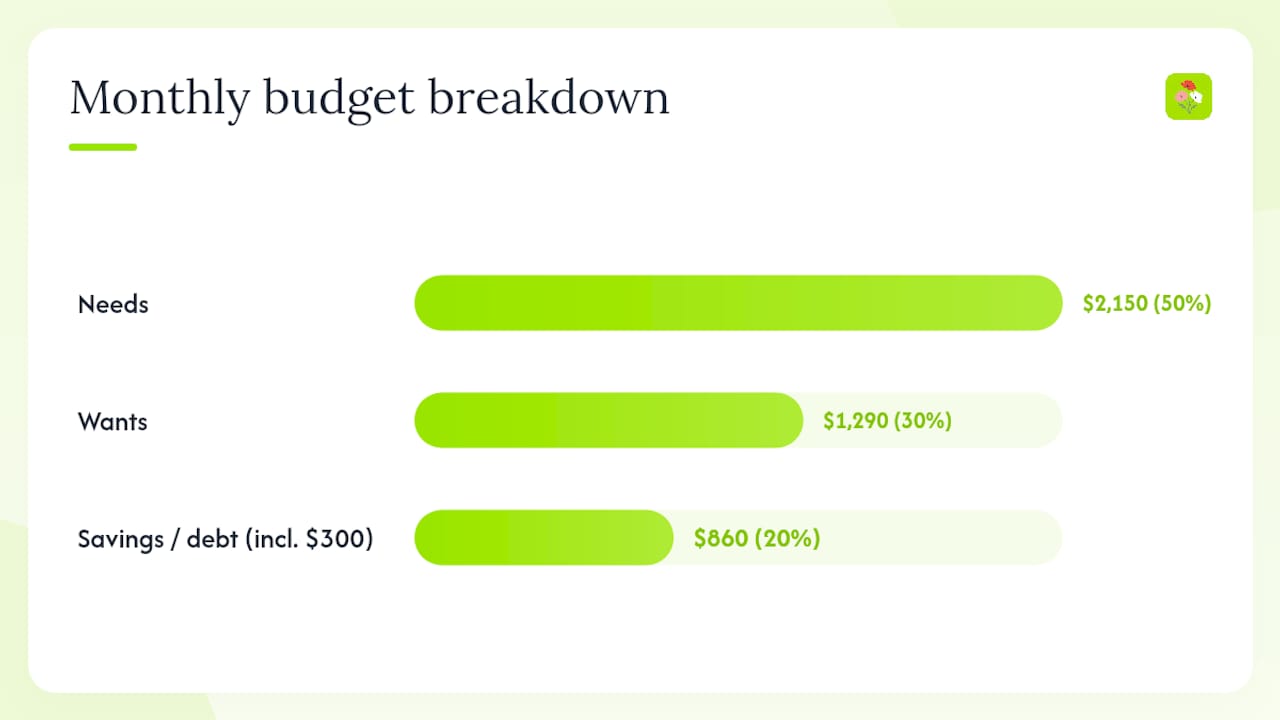
Your 401(k) contribution ($300) counts toward that $860 savings target, leaving $560 to direct toward an emergency fund, extra debt payments, or a sinking fund.
Step 3: Track one month of real spending
Pull your bank and credit card statements. Categorize every transaction as a need, want, or savings. Most people discover their needs are higher than expected and their wants are scattered across dozens of small charges. NerdWallet's budget calculator can speed this up by letting you enter your net income and see the target dollar amounts instantly.
Step 4: Automate what you can
Set up an automatic transfer to savings on payday, before you spend anything. Schedule minimum debt payments as auto-pay. Use your bank's bill-pay feature for fixed monthly bills.
Pro Tip: Set your savings transfer to hit your account the same day as your paycheck. You won't miss money you never see sitting in checking.
When the 50/30/20 rule doesn't fit your situation
Ramsey Solutions points out that for many households, needs alone consume more than 50% of take-home pay, making strict adherence unrealistic. High rent in a major city, large student loan minimums, or a single income supporting a family can all push needs past that threshold.
Here's how to adjust:
| Situation | Suggested ratio | Logic |
|---|---|---|
| High cost-of-living area | — | Needs get more room; wants shrink |
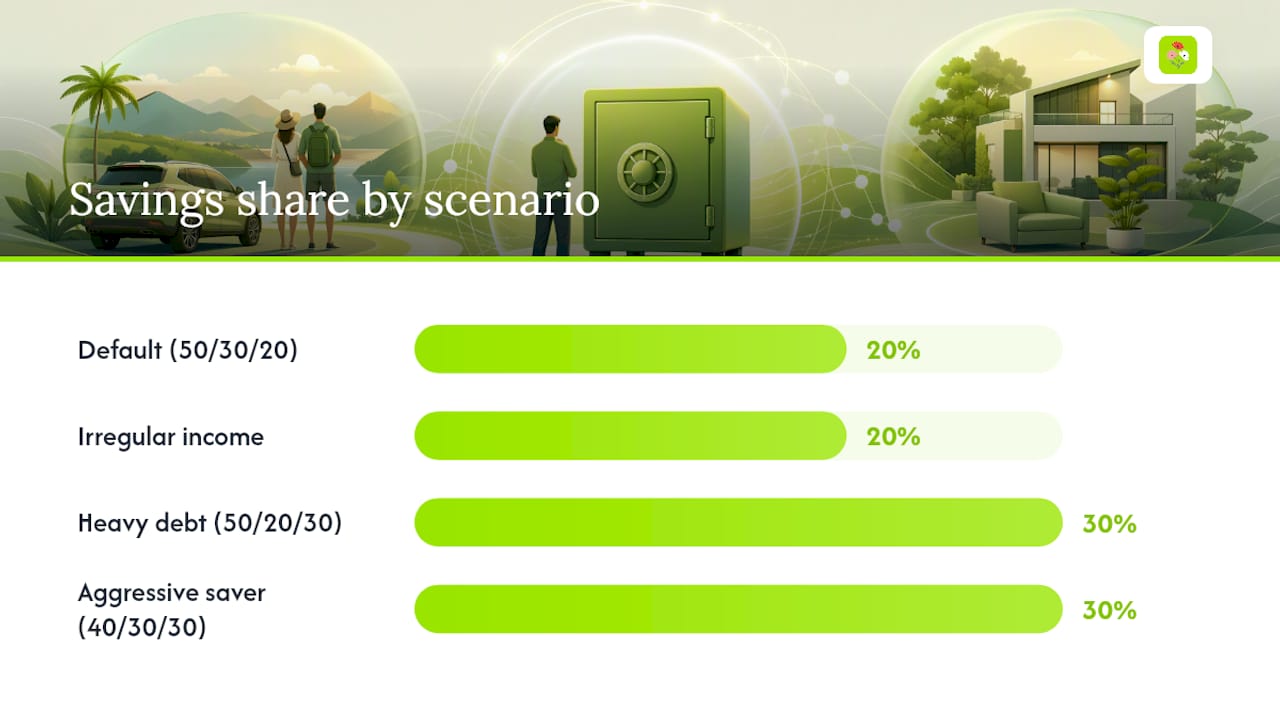
| Heavy debt load | 50/20/30 | Flip wants and savings; attack debt faster |
| Aggressive saver | 40/30/30 | Reduce needs (smaller apartment, no car) to save more |
| Irregular income | Savings-first | Move 20% to savings on every payment received; spend what remains |
The key is to test any new ratio for 1–3 months before deciding it's your permanent structure. Life changes, and your budget should too. Forbes Advisor is explicit that the rule was designed as a template, not a mandate.
For freelancers and anyone with variable monthly income, a savings-first approach often works better than strict percentages. Move your savings target off the top of every payment, then allocate what remains to needs and wants. This prevents the common trap of spending a big month's income as if every month will look the same.
Tools and templates that make this practical
You don't need anything fancy to run a 50/30/20 budget. A few options:
- Simple calculator: — Multiply your net income by 0.50, 0.30, and 0.20. Done. Or use NerdWallet's budget calculator to get the dollar amounts in seconds.
A budgeting app adds real value once you have more than one account to track. Tended automatically consolidates your accounts, applies category rules to transactions, and supports budget rollover so unspent sinking fund money carries forward instead of disappearing at month's end. For freelancers with irregular deposits, that rollover feature matters more than any percentage formula.
Pro Tip: If your employer withholds a 401(k) contribution pre-tax, count it in your 20% savings bucket from day one. That way you're not tempted to "save again" from your net deposit and accidentally over-allocate to savings while underfunding needs.
Key Takeaways
The 50/30/20 budget works because it gives every dollar a clear category from the moment your paycheck arrives, using net income as the base.
| Point | Details |
|---|---|
| Use net income as your base | Build the budget on after-tax pay; add back pre-tax deductions to avoid double-counting savings. |
| Three clear buckets | 50% needs, 30% wants, 20% savings and debt repayment — adjust ratios when housing or debt pushes needs past 50%. |
| Automate savings first | Transfer savings on payday before spending; this single habit drives adherence more than any spreadsheet. |
| Subscriptions are wants | Rising subscription costs can quietly erode the 30% bucket — audit them every few months. |
| Tended supports the system | Tended consolidates accounts, applies category rules, and rolls over unspent sinking fund money for irregular earners. |
The budget is a tool, not a report card
Most budgeting advice treats a missed target as a failure. It isn't. A month where your needs ran to 55% because your car needed a repair is not a broken budget. It's a data point.
The 50/30/20 framework is most useful not as a strict rule but as a mirror. When your wants creep to 40% for three months in a row, that's worth noticing. When your savings bucket stays at 5% despite good intentions, something structural needs to change, not just your willpower. The framework shows you where the money actually went, which is the only honest starting point for changing where it goes next.
Small, consistent adjustments compound. Cutting one subscription, moving $50 more to savings, or reclassifying one "need" that's really a want, none of these feel significant in month one. Over a year, they shift the whole picture. Give yourself permission to start imperfect and improve from there.
Tended makes the 50/30/20 rule easier to stick with
Knowing the percentages is the easy part. Tracking them across multiple accounts, catching miscategorized transactions, and smoothing out irregular income months is where most people fall off.

Tended consolidates all your bank accounts in one place, applies custom category rules so transactions land in the right bucket automatically, and carries unspent sinking fund money forward with budget rollover. For freelancers or anyone whose income varies month to month, that rollover feature keeps the 20% savings target realistic even when one month is leaner than the next. There are no rigid structures to fight against. The app adapts to how you actually earn and spend.
Visit tended.money to connect your accounts and see your 50/30/20 split in real numbers. The Tended blog also has templates and guides for tracking categories and handling irregular income.